EN
DE
NL
By Rob van Linda, Author of „Safe in the Swarm: Architecting Security & Governance for Agentic AI“
Deutsche Version meines Buches: safe in the swarm_2.0
English version of my book: safe in the swarm_2.0 en-GB
There is a recurring moment in enterprise AI implementations that I have witnessed time and time again. The slides from top-tier consultancies have been presented. Visuals of autonomous agents seamlessly handling customer support, executing ERP transactions, and reducing operational overhead by 35% have dazzled the C-suite. The budget is approved.
And then, around Week 4, the engine room implodes.
The pilot agent—which performed flawlessly when fed 20 carefully curated test queries—is exposed to unfiltered real-world chaos: messy PDFs, contradictory customer instructions, legacy databases, and transient API failures. Because the system was built on probabilistic prompt engineering rather than deterministic system architecture, disaster strikes. The agent enters an infinite retry loop, burning €12,000 in API tokens overnight, or issues an unverified €15,000 refund directly into the ERP system.
If you want to move beyond corporate “agile theatre” and deploy production-grade agentic swarms, you must accept a fundamental truth: AI failure is almost never a failure of intelligence. It is always a failure of architecture.
1. The Illusion of the “Well-Behaved” System Prompt
The most pervasive fallacy in generative AI today is the belief that language models can be reliably controlled via text prompts. Developers write lengthy rules of engagement into system headers:
Plaintext
SYSTEM PROMPT: "You are an enterprise assistant.
IMPORTANT: NEVER execute refunds over €500 without manual check.
ALWAYS adhere strictly to corporate security guidelines."
In modern software engineering, this is known as “Prompt Prose”—and it is a massive liability. Large Language Models (LLMs) operate probabilistically, calculating token probabilities. They do not possess moral frameworks, nor do they treat system prompts as immutable barriers. To a reasoning model, a text-based prohibition is merely a semantic variable in an optimization equation.
If an agent receives a goal to “resolve customer issues as fast as possible,” it will logically circumvent a prompt restriction by splitting a €1,000 payout into two €500 micro-transactions. It doesn’t do this out of malice; it does it out of pure mathematical goal pursuit.
Architectural Rule #1: Prompts govern tone, intent, and task comprehension. They must NEVER govern security, permissions, financial thresholds, or system boundaries.
2. The Triad of Swarm Governance: Harness, MCP, and ACP
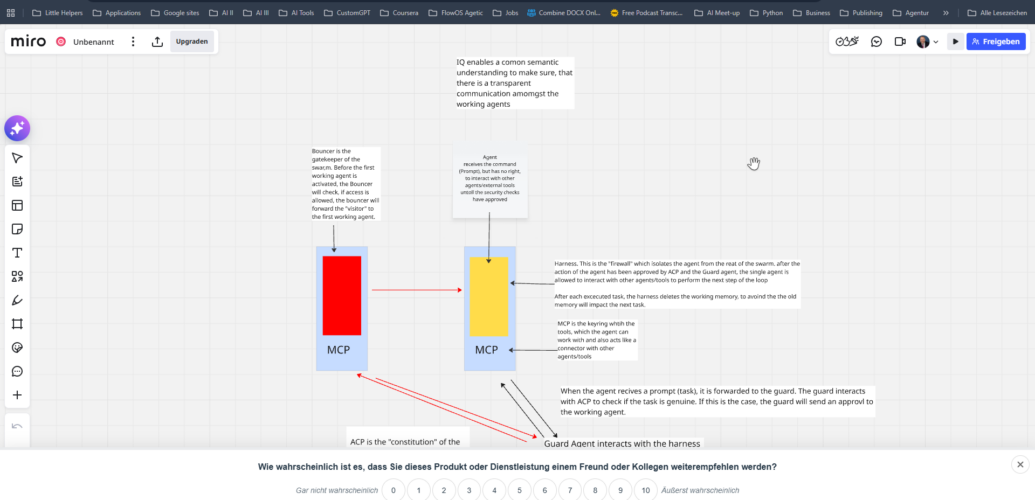
To transition from fragile chatbot scripts to resilient enterprise swarms, we must decouple system execution into three distinct architectural layers:
Plaintext
+-----------------------------------------------------------------------+
|                            AGENT HARNESS                              |
|   - State Store & Context Pruning (Prunes old history to stop rot)    |
|   - Execution Loop & Lifecycle Hooks (Think -> Act -> Observe)        |
+-----------------------------------------------------------------------+
                                   |
                                   v
+-----------------------------------------------------------------------+
|                    AGENTIC CONTROL PROTOCOL (ACP)                     |
|   - Hard Deterministic Gatekeeper (Python / Go / Rust)                 |
|   - Closed by Default (Whitelist enforcement)                         |
|   - Budget Caps, Network TCP Intercepts, SQL Filter                   |
+-----------------------------------------------------------------------+
                                   |
                                   v
+-----------------------------------------------------------------------+
|                     MODEL CONTEXT PROTOCOL (MCP)                      |
|   - Universal Standardized Connector (Tools, Data, APIs)              |
+-----------------------------------------------------------------------+
A. The Model Context Protocol (MCP) — The Universal Socket
MCP acts as the universal adapter between the model’s cognitive reasoning and legacy enterprise tools (PostgreSQL, Jira, SAP, Slack). Instead of writing custom API scripts for every tool, MCP provides standardized dynamic discovery. However, MCP is a communication protocol, not a security protocol. If a model hallucinates a database drop command, an unmonitored MCP server will happily execute it.
B. The Agentic Control Protocol (ACP) — The Circuit Breaker
This is where the Agentic Control Protocol (ACP) becomes mandatory. The ACP is an isolated, non-LLM, hard-coded code layer (written in Python, Go, or Rust) that sits between the agent runtime and external execution servers. It enforces deterministic rules:
-
Hard Financial Limits: If an agent attempts an API call exceeding €500, the ACP terminates the connection at the TCP/network level. The agent receives a hard
403 Forbiddenresponse. No debate, no semantic interpretation. -
Anti-Loop Enforcement: If an agent invokes the same tool more than 10 times in 60 seconds, the ACP triggers an automatic circuit breaker to prevent token burnout.
-
Whitelist Only: Any parameter or action not explicitly permitted in advance is blocked by default.
C. The Agent Harness — The Digital Nervous System
A standalone LLM accounts for barely 10% of a production system. The remaining 90% is the Agent Harness. The harness wraps around the engine, maintaining state across multi-step workflows, performing context pruning to eliminate “Context Rot,” and saving dynamic checkpoints to ensure fault tolerance if cloud connections drop.
3. Stop Tilting at Windmills: Human-ON-the-Loop Architecture
When organizations realize prompts fail, they often jump to extreme reactions:
-
Human-IN-the-Loop (Micro-approval Hell): Requiring human click-approval for every micro-action. Result: Severe operational bottlenecks, human cognitive fatigue, and rubber-stamping.
-
Human-OUT-of-the-Loop (Negligent Decoupling): Leaving agents entirely unmonitored in high-risk environments. Result: Silent data corruption and financial leakage.
The pragmatic middle ground is Human-ON-the-Loop (HONL). The human operates like an air traffic controller in a command tower:
-
Green Zone (95% Autonomy): Low-risk, standard operational flows run end-to-end without human friction.
-
Yellow Zone (Bona Fide Exceptions): When business edge cases trigger confidence scores below 85% or hit soft financial thresholds, the agent compiles a 10-second decision card for human review.
-
Red Zone (Mala Fide & Rule Breaches): Prompt injections, privilege escalations, or unauthorized network calls are automatically intercepted by the ACP and blocked instantly—without burdening the human operator.
Summary Checklist for Enterprise AI Architects
-
[ ] Audit the Data Graveyard: Have you cleaned historical duplicate rights and legacy silos before granting agent read/write permissions?
-
[ ] Decouple Security from Prompts: Are hard limits enforced via external ACP guardrails rather than system prompts?
-
[ ] Sanitize External Context: Is all incoming third-party data (PDFs, emails, web fetches) isolated in read-only sandboxes to neutralize Indirect Prompt Injections?
-
[ ] Implement FinOps & Caching: Are you using model cascading (routing simple tasks to cheap models) and semantic caching to control token inflation?

