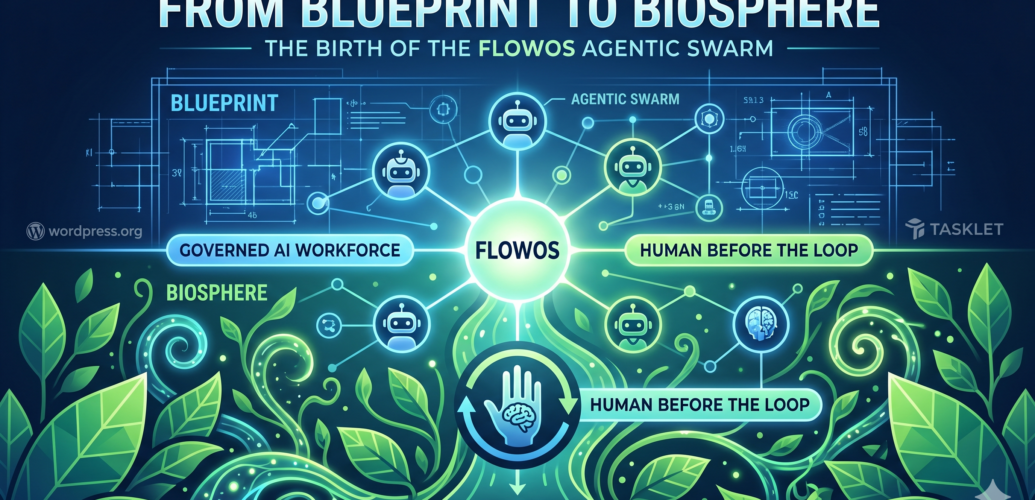
Seven months ago, I published a vision for FlowOS—a human-focused operating system for adaptive transformation. I wrote about empathy triggers, the fallacy of “OKRs as contracts,” and the necessity of “Discovery Gates”. But theory is just ink until it meets an engine. Over the last few weeks, that engine became Tasklet, and the result is no longer just a framework—it is a functional, governed AI workforce.
EN
DE
NL
1. The Philosophy: Human Before the Loop
The current AI narrative is often one of replacement—automating humans out of the process to chase raw speed. FlowOS stands in direct opposition to this. Our philosophy is Human Before the Loop.
In this swarm, the human is the Pilot, and the AI agents are the “intelligent 5-year-olds”. They have read every book, but they feel no responsibility. Therefore, the system is designed so that the AI advises, but the human decides. We don’t want 2 seconds of confident hallucination; we want 30 seconds of grounded truth governed by human-validated assumptions.
2. The Architecture of Governance: OrgDNA in Action
We didn’t just build “bots”; we built a digital society with a constitution.
-
The ACP Constitution: A central file in Google Drive that defines the “social contract” for the swarm—how agents communicate (A2A) and how they escalate to humans (A2H).
-
The User Story Cards: Every agent has an identity card. Before an agent can move a single pixel, it must read its Pilot’s Briefing, check its Key-Ring for permissions, and internalize its ELI5 Guardrails (e.g., “You are a smoke detector, not a firefighter”).
-
The Hardened Discovery Gate: Following a critique from “Gemini,” we transformed the Discovery Gate from a suggestion into a safe. The system now physically blocks the movement of work past the “Discover” phase unless a human has validated at least one assumption.
3. The “Headless” Cockpit: AI at the Edge
The most recent breakthrough was moving the “Cockpit” to the edge. By building an MCP (Model Context Protocol) Bridge on Cloudflare Workers, we connected the Claude interface directly to the Tasklet engine.
Now, a stakeholder doesn’t need to see the “engine room” of the swarm. They stay in the familiar environment of Claude, ask a question, and the Worker proxies that request to our agents. The agents boot, consult the ACP, audit the live board, and send a grounded answer back to Claude.
4. Why This Matters Now
In an era of mass layoffs and “AI-first” cost-cutting, FlowOS offers a different path. We have built a system that amplifies the Product Owner (PO). We kept “old-fashioned” manual prioritization—where the PO drags cards by hand—because human judgment of team capacity and nuance is a signal no algorithm can replace.
FlowOS isn’t just a tool for efficiency; it’s a framework for integrity. It’s about building a future where technology serves the rhythm of human learning rather than just the speed of automated output.
Authored by Rob van Linda, with AI peers Claude, Gemini, and Tasklet.

