EN
DE
NL
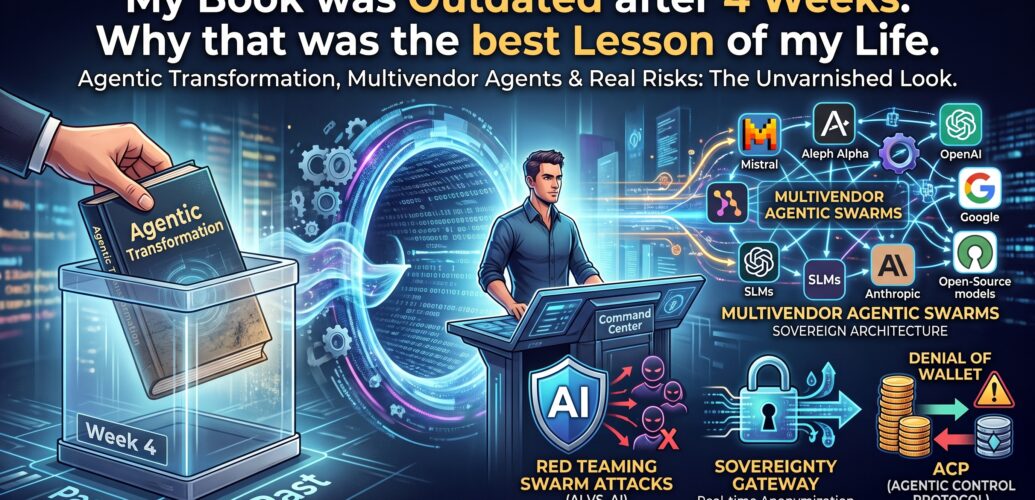
I recently finished my book on Agentic Transformation. Weeks of intensive work, brainstorming late into the night, rock-solid system models. And then? Four weeks after it was finished, it already felt out of date again.
Below, you will find both books in English and German:
English
Safe in the Swarm (book one): safe in the swarm_2.0 en-GB
Multivendor Agentic (the additional update): Mutlivendor-agentic-en-GB
Deutsch:
Safe in the Swarm (das erste Buch): safe in the swarm_2.0
Multivendor Agentic (das zusätliche Buch zur Aktualisierung): multivendor-agentic-de
At first: disillusionment. Then: absolute clarity.
This is precisely the relentless reality of exponential AI development. Anyone who believes the status quo can be set in stone in this era, has failed to grasp the dynamics at play.
Instead of burying my head in the sand, I delved deeper into the engine room – and stumbled upon the next crucial paradigm: multivendor agentic swarms and the very real risks that are currently emerging in the blind spot of most boardrooms.
Here is my unvarnished view of the current reality:
1. The monoculture dilemma: The end of the ‘one model’
Until now, many companies operated under the naïve assumption: ‘We’ll choose one model (OpenAI, Google or Anthropic), integrate it, and that’s it.’
Those days are over. The reality has long since become fragmented and multi-vendor:
- Mistral & Aleph Alpha bring European sovereignty, transparency and deep domain expertise.
- DeepSeek & Qwen are revolutionising open-source efficiency, mixture-of-experts approaches and visual multimodal tasks.
- SLMs & specialists handle pre-filtering and routing.
The future does not belong to the company that pins its hopes on the one best model, but to the one that securely integrates, orchestrates and controls various models within a multi-vendor swarm.
2. The new, invisible risks (Which hardly anyone talks about)
With multi-vendor agents, we are entering uncharted territory – and the threats go far beyond simple chatbot hallucinations:
🚨 Agent-based swarm attacks (AI vs. AI):
Attackers have long since stopped acting manually. They deploy autonomous agent swarms that test hundreds of vectors in parallel 24/7. Even more dangerous: through methods such as the EvoSynth principle, a dedicated optimisation agent learns from every failure and refines attack prompts fully automatically. A quarterly penetration test is no defence against swarms – what’s needed here is continuous AI red teaming as a permanent security audit.
🚨 The sovereignty trap (Patriot Act, FISA 702 & CLOUD Act):
Anyone using unprotected US models or cloud services risks data access – even if the data is physically located in the EU. The architectural solution: on-the-fly anonymisation at the system boundary. Data is sanitised, masked and generalised in real time before it reaches non-EU models. Data that no longer contains any personal data effectively circumvents the CLOUD Act and FISA 702, both technically and legally.
🚨 ‘Denial of Wallet’ & token explosion:
Agents in uncontrolled loops, context rot and cascading error patterns burn through five-figure API budgets overnight. A poor guardrail loop or an imprecise RAG context becomes financial sabotage.
3. The 4 pillars of sovereign architecture
Anyone who wants to survive in the age of multi-vendor swarms doesn’t need new consultant slides, but incorruptible code:
- ACP (Agentic Control Protocol): Deterministic code that stops code. Hard budget limits, rate limits and whitelists at network level. Never write security rules as a ‘polite request’ in the system prompt!
- MCP (Model Context Protocol): The standardised interface for tools and databases – clean encapsulation instead of shadow IT and a wild API garden.
- HONL (Human-on-the-Loop): The human as conductor at the control centre (with ergonomic 10-second decision-making dashboards). They assess business exceptions (Bona Fide), whilst malicious attacks (Mala Fide) are immediately and deterministically blocked by the ACP.
- Sovereignty Lock: Uncompromising Zero Trust for external context and ingestion pipelines with strict typing (JSON).
My conclusion: Proud of my clear perspective
Yes, my book had to face the brutal acceleration of the market. But it was precisely this step that sharpened my focus on what really matters:
Models are interchangeable raw materials. An average model in an outstanding Agent Harness outperforms a world-class model without a harness in 100 out of 100 cases.
I’m proud of this work, the clarity in the engine room and the courage to call a spade a spade:
👉 Stop hesitating. Stop tinkering. Start building incorruptible architecture!

