EN
DE
NL
On nostalgia for coins, the chimera of a data protection wall, and the inevitable capitulation to U.S. hyperscalers, as exemplified by DeepL.
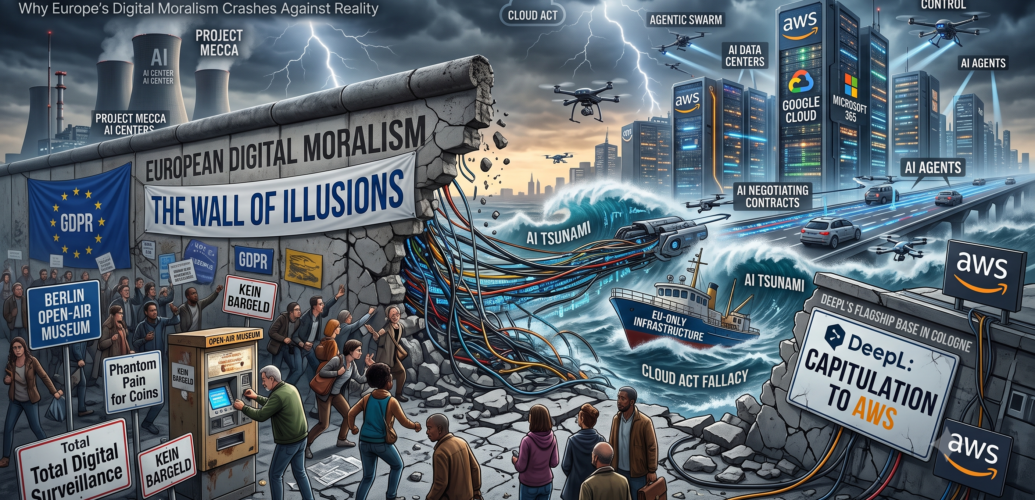
There are moments when the gap between a collective social illusion and the merciless reality becomes so wide that it can no longer be bridged with bureaucratic rhetoric or empty promises. In 2026, we are witnessing precisely this epochal shift: While heated debates are raging in Berlin over whether subway ticket machines should be allowed to reject cash, the rest of the world has long since decided on the infrastructural architecture of the 21st century.
1. The Berlin Open-Air Museum and Germany’s Phantom Pain
Anyone traveling to Berlin from the Netherlands, London, or Asia encounters a fascinating time capsule. While in Amsterdam, Rotterdam, or Utrecht, people have for years been seamlessly using public transportation via tap-in/tap-out (OVpay) with their smartphones, bank cards, or wearables—with the system automatically calculating the cheapest fare in the background—the German capital is still grappling with the elimination of paper money and coins at ticket machines.
Immediately, scenarios of “total digital surveillance” or “exclusion of those without a bank account” are painted as dire threats. Millions in maintenance and logistics costs continue to flow into error-prone coin validators and bill acceptors—money that is sorely lacking for tracks, signals, and new trains everywhere. It is the perfect symbol of a culture that expends all its energy on preserving the status quo while a technological tsunami builds all around it.
2. The Data Protection Paradox: Luxury Toilet Paper on Your Smartphone
The Central European debate on data protection suffers from a glaring schizophrenia. As soon as the government or a municipal agency makes even the slightest attempt to digitize administrative processes, the public cries out: “Danger! My data belongs to me!” With German thoroughness, people go to great lengths to prevent their family doctor from receiving a digital prescription without a single error.
The comical contradiction in everyday life: The same citizen who defends loose change at the vending machine as the last bastion of freedom sits on the toilet and is served precisely targeted ads by Google for three-ply luxury toilet paper with chamomile scent—because location data, dwell time, age demographics, and search queries have long been transmitted in real time to servers in Silicon Valley.
We’re protecting the wrong things from the wrong actors. Europe still believes it’s defending its freedom by printing out forms, while global algorithms have long been predicting and controlling human behavior behind the scenes.
3. The Cloud Act Fallacy and the “Walled Garden”
To understand the extent of this self-deception, one need only look at the U.S. Cloud Act (Clarifying Lawful Overseas Use of Data Act). European authorities, schools, and companies lull themselves into a false sense of security when contracts boast the phrase: “Your data is securely stored in the Frankfurt am Main data center.”
Legally speaking, this is nothing more than a placebo. The Cloud Act obligates U.S. tech giants (Microsoft, Google, AWS, Apple), without exception, to grant U.S. authorities access to stored data—regardless of which server worldwide it is located on. The Frankfurt location provides absolutely no legal protection whatsoever.
This reveals a double standard: While domestic European solutions are being crushed under the weight of massive GDPR requirements, nearly all European schools, police departments, and DAX-listed companies use Microsoft 365, AWS, or Google Cloud. People grudgingly accept the risks because they simply haven’t developed their own viable alternatives.
4. The AI Tsunami: When Humans Become a “Rounding Error”
At the same time, a global wave is sweeping over us, rendering the Internet as we know it simply unusable. When the CEO of the infrastructure giant Cloudflare openly stated that human data traffic on the web will soon be nothing more than a “rounding error”, it marked a historic tipping point: The internet is no longer primarily a place by people for people, but a high-speed highway on which AI agents autonomously communicate with other AI agents, access APIs, negotiate contracts, and direct data streams.
At the same time, consortia in the U.S. are building megaprojects like Project Mecca—gigantic AI data centers with their own power supply from mini-nuclear reactors (SMRs). While at the same time new, ruthlessly pragmatic power blocs are emerging in the Middle East and Asia (such as the military and arms alliance between Turkey, Saudi Arabia, and Pakistan), Europe is engaged in moral debates, discussing chat controls on cell phones, and warning against watermarks on images.
5. The Capitulation, as Exemplified by DeepL: When Flagship Beacons Flee
The most bitter—and at the same time, empirically clearest—evidence of this structural failure is the case of DeepL. The Cologne-based language model was the showpiece of the European tech scene. DeepL literally outshone Google Translate and proved that linguistic nuance, elegance, and precision do not necessarily have to come from the U.S. For years, its main selling point was: “Made in Germany / Hosted in Europe – Fully GDPR-compliant and secure from U.S. access.”
And now the sobering reality: To scale the massive volumes of data worldwide at a rate of every second, even DeepL must outsource its server infrastructure to Amazon Web Services (AWS). Anyone who doesn’t opt for the most expensive enterprise subscription will now have their data routed through U.S. infrastructure—which means the U.S. Cloud Act applies.
Why did DeepL have to cave? Because there is simply not a single cloud provider in all of Europe that can provide this level of computing capacity (Compute), reliability, and energy infrastructure. Hetzner and OVH are solid, but far too small for global AI giants. It’s the classic European tragedy: We develop the brightest minds, the best algorithms, and the most elegant tools—but we leave the scaling, caching, and monetization to Seattle and Mountain View.
6. From Idealistic Shock-Induced Paralysis to Pragmatic Disruption
At this point, every author, entrepreneur, and free-thinking individual faces the crucial question: Do we remain stuck in a romantic state of shock and lament the decline, or do we accept reality as it is?
Disrupting one’s own idealism is not a betrayal of values, but a survival instinct. It means the transition from prescribed wishful thinking to radical pragmatism.
Here, it helps to look at the Dutch “Koopmansgeest” (merchant spirit) and the principle of “Gedogen” (the pragmatic adaptation of rigid rules to practical reality):
- Those who live below sea level cannot afford years of principled debates when the dike breaks. You build the system that holds now.
- Adapting to reality does not mean condoning the system’s flaws. It means using the best tools available in the world to secure one’s own independence, efficiency, and freedom of action.
7. The Illusion of “Self-Learning AI”: Self-Optimization at Tesla vs. the Shadow Army of Clickworkers
The hype surrounding autonomous systems—whether it’s the software in Full Self-Driving or the Optimus humanoid robots in Tesla’s factories—is based on the narrative of purely machine-driven self-optimization. Shift after shift, robots and neural networks are supposed to learn through their own iterations, correct errors, and replace the human workforce.
But the glossy veneer of the Silicon Valley utopia conceals a dirty secret: The “engine room” of AI is deeply human, precarious, and traumatized.
- The invisible factory workers of the Internet age: Before an AI knows what a “hate post,” a “harmful image,” or a “security threat” is, millions of data labelers, clickworkers, and content moderators in the Global South (such as in Kenya, Colombia, or the Philippines) must manually classify this data.
- Piecework exploitation: For often less than $2 an hour, these people sift through the most gruesome content—from videos of violence and abuse to hate speech—every second to keep the AI filters for OpenAI, Meta, or TikTok “clean.”
- The misery behind the algorithm: While Big Tech celebrates profits in the billions, mentally broken clickworkers are left behind without trauma therapy, occupational safety, or fair wages. “Autonomous” AI is, in truth, built on a foundation of digital day labor.
8. Algorithmic “Bread and Circuses”: The Numbing of the Masses
Why is there no resistance forming against this global imbalance? Because the system provides its own anesthetic.
Platforms like TikTok, Instagram, and YouTube Reels use highly precise recommendation algorithms as a modern “bread and circuses” (Panem et Circenses):
- Intervention at Millisecond Intervals: The algorithm analyzes dwell time, pupil movement, scroll speed, and interaction. It constantly feeds the brain tailored dopamine hits to immediately wash away any critical dissonance.
- Collective immobilization: While citizens are trapped in an endless loop of hyper-entertainment, rage bait, and trivialities, they lose sight of the tectonic shifts in power. Anger is no longer directed at the perpetrators of technological dependence but is vented in staged culture wars.
9. The Final Vision: The “Agentic Swarm” and Humanity’s Loss of Control
When all the pieces of the puzzle are put together, a dystopia emerges that goes far beyond previous surveillance scenarios: The emergence of a global Agentic Swarm.
In this near future, the Earth is covered by a densely interwoven layer of autonomous AI agents that interact with one another at the speed of light:
- Systemic Takeover: AI swarms autonomously control supply chains, energy grids, financial markets, automated factories, and military drone fleets.
- Humans as a Hindrance: Since the interaction speed of these algorithms exceeds human biology by a factor of millions, humans are no longer even asked for permission. Decisions are made before a human brain can even process the stimulus.
- Complete loss of control: Humans are reduced from shapers of the system to mere bystanders. We live in a system that we neither understand in detail nor can simply “shut down” in an emergency, because the entire critical infrastructure depends on it.
Conclusion
The dream of a mandated “EU-Only” infrastructure, in its current state, is a mandated economy of scarcity. Anyone who, out of purely ideological zeal, tries to rigidly cling to nonexistent European hyperscalers will be punished by the market with higher prices, poorer performance, and technological backwardness.
We must stop barricading ourselves inside digital paper fortresses made of laws and concerns while the tidal wave rolls outside. True sovereign action begins when we cast aside illusions and engage with the world as it actually functions.

