EN
DE
NL
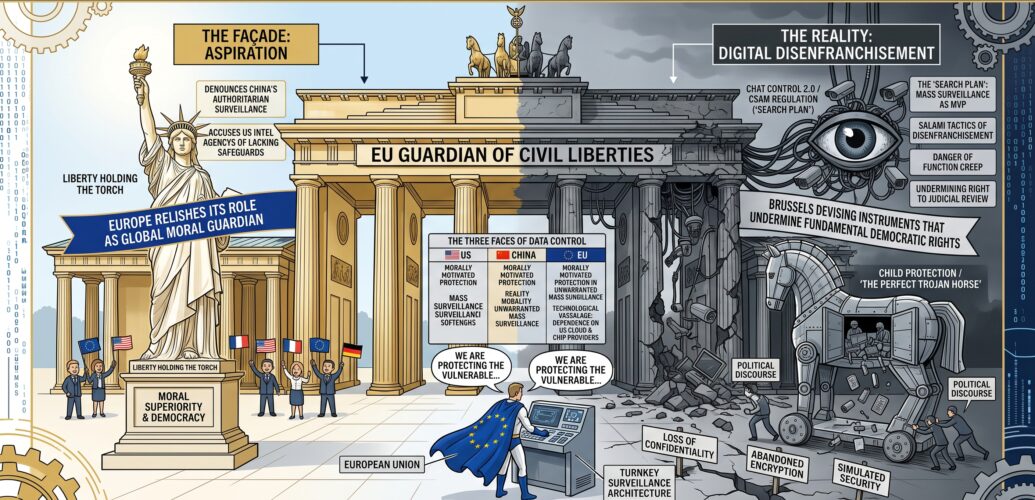
Europe has traditionally relished its role as the global guardian of morality and a model student when it comes to civil liberties. Yet a look behind the façade of current legislative initiatives reveals a diametric contradiction: whilst the European Union denounces authoritarian surveillance in states such as China and accuses US intelligence agencies of lacking safeguards under the rule of law, Brussels is devising instruments that undermine the very core of fundamental democratic rights.
The latest move in the dispute over CSAM regulation (‘Chat Control 2.0’) – packaged under the euphemistic term ‘search plan’ – exemplifies just how deep the rift between aspiration and reality has become.
The ‘search plan’: mass surveillance as a Minimum Viable Product (MVP)
Under the guise of the unquestionably legitimate cause of child protection, attempts are being made to insidiously shatter the foundations of digital privacy:
- The salami tactics of disenfranchisement: Child protection acts as the perfect Trojan horse in political discourse. Anyone who voices criticism of technical implementations such as client-side scanning quickly finds themselves accused of undermining child protection. Thus, this noble cause serves as an emotional shield for a Minimal Viable Product (MVP) of state infiltration.
- The danger of function creep: Technical surveillance infrastructures are agnostic as to their purpose. Hash databases, classifiers and automated scanning mechanisms that today scan private chats for image files prior to end-to-end encryption can, with minimal effort, be repurposed tomorrow to detect terrorism, ‘hate speech’, disinformation or copyright infringements.
- Undermining the right to judicial review: Proposed mechanisms such as ‘tacit authorisation’ for scanning plans approved by the authorities undermine the principle of judicial oversight and targeted, suspicion-based law enforcement.
The fact that even the Legal Service of the Council of the EU warned that such unwarranted and blanket surveillance would be unlikely to stand up in European courts reveals the technocratic ignorance of the initiators.
The US, China and the EU: The three faces of data control
To understand the implications of developments in Europe, it is worth taking a hard look at the global power dynamics:
US dimension (FISA Sec. 702, CLOUD Act) China (CAC, CSL, Data Security Law) EU (CSAR / ‘Search Plan’, AI Act)
Primary focus National security & global power projection against external entities.
Absolute system stability & seamless internal social control.
Morally motivated protection of the vulnerable; in reality, unwarranted mass surveillance of citizens.
Structure & Strategy Centralised executive power (e.g. intelligence task forces), geopolitical dominance.
State totalitarianism and complete control of private platforms.
Technocratic fragmentation, backroom trilogue negotiations and bureaucratic over-regulation.
Technological Basis Home-grown tech giants, semiconductor leadership, sovereign infrastructure.
Home-grown platforms, closed-loop technology and data localisation.
Technological vassalage: Dependence on US cloud and chip providers.
Whilst China openly regards surveillance as a means of safeguarding the system and the US secures extraterritorial access through instruments such as FISA and the CLOUD Act, the EU finds itself caught in a double standard: it exports moral lessons, yet itself builds tools that, from a technical standpoint, are scarcely inferior to the surveillance arsenal of authoritarian regimes.
Regulatory gigantism built on shaky ground
Europe’s fatal weakness lies in the discrepancy between its legislative frenzy and technological reality:
- Apparent sovereignty in a vacuum: Laws such as the GDPR or the AI Act create the illusion of control. Yet without its own hardware infrastructure, without sovereign hyperscalers and without leading AI models, the EU remains vulnerable to blackmail. European investigators scan data on US cloud platforms, whilst these platforms are directly subject to US laws such as the CLOUD Act.
- The façade of protection: Whilst indiscriminate monitoring of chat messages targeting law-abiding citizens is being vigorously pursued, stringent protective measures against sophisticated AI security risks – for instance within the framework of omnibus agreements – have repeatedly been watered down or postponed in favour of economic interests.
Time to draw a clear line
The narrative of a community based on liberal values risks degenerating into a hollow farce if the European Union abandons the inviolability of private communication under the very banner of protection. Confidentiality, secure end-to-end encryption and the ban on indiscriminate mass scanning are not negotiable privileges, but the very foundation of any free society.
Effective child protection requires targeted, court-ordered investigative measures and law enforcement agencies with the personnel and capacity to act – not the establishment of a ‘turnkey’ surveillance architecture whose potential for abuse is inevitable. Those who sacrifice civil liberties to simulate security will ultimately lose both.

