EN
DE
NL
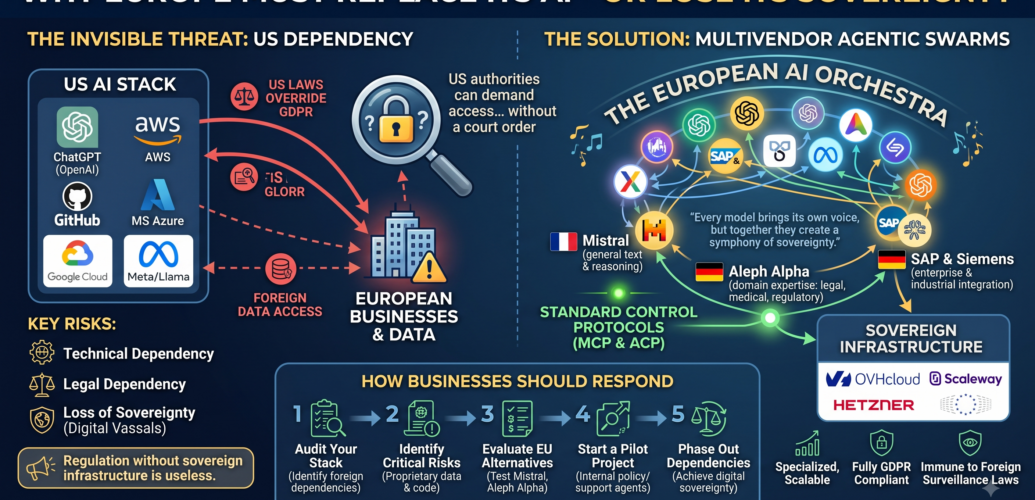
When we talk about AI security, we often focus on data privacy or leaks. But there is a much bigger, invisible threat: Systems that control our entire digital future.
If your business relies on US-based AI models and cloud infrastructure, your systems are subject to US law—regardless of where your servers or headquarters are located.
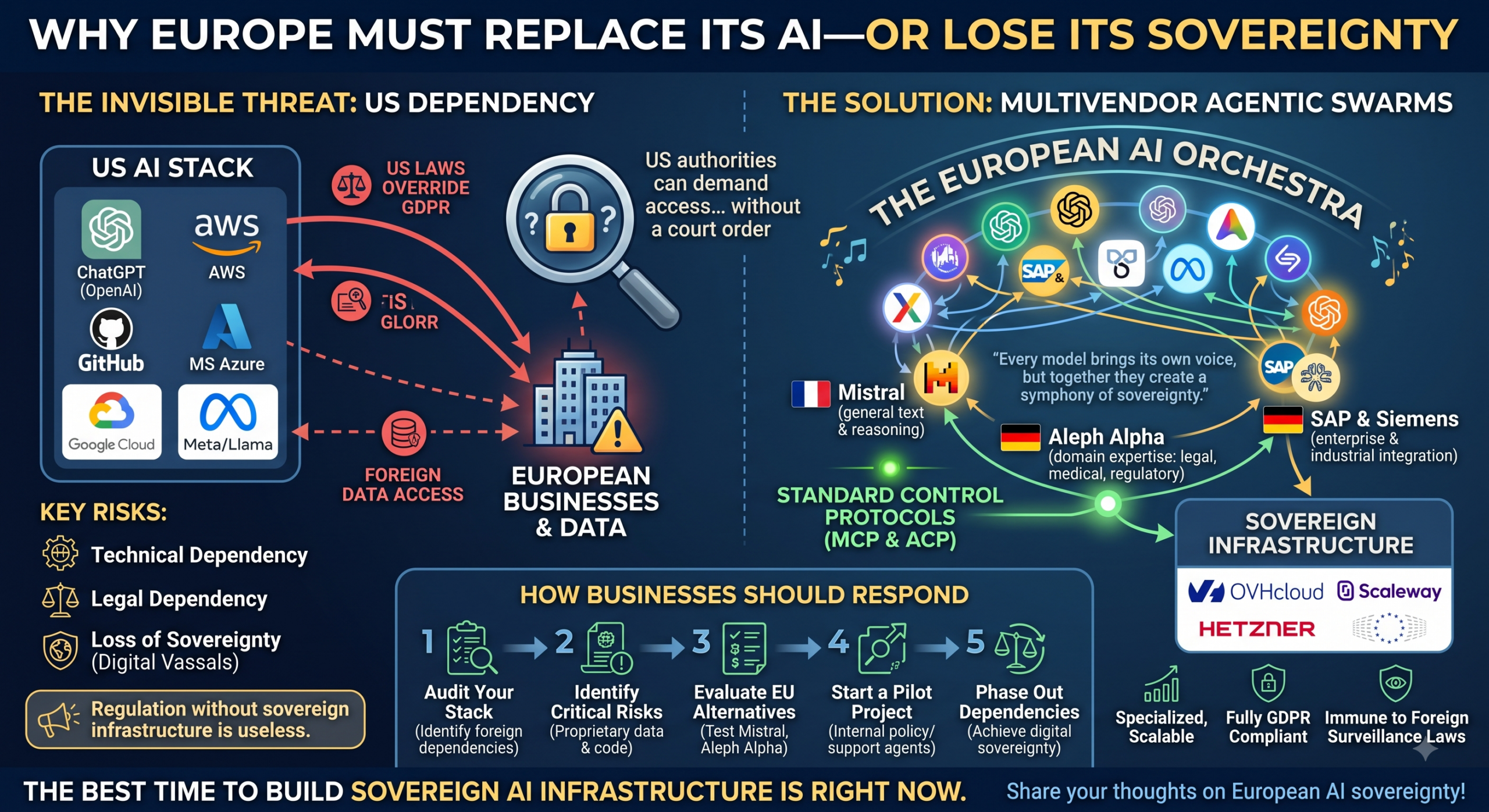
Through the combination of the Patriot Act, FISA 702, and the CLOUD Act, US authorities can demand access to data hosted on US infrastructure—without a court order, without notifying you, and even if that data is stored inside European data centers.
The Reality of the US AI Stack
Whether it’s an employee asking ChatGPT a question, a startup hosting models on AWS, or a enterprise using GitHub:
-
Technical Dependency: Key AI models, clouds, and dev tools remain locked in US ecosystems.
-
Legal Dependency: US surveillance laws override local protections like GDPR.
-
Loss of Sovereignty: European businesses run the risk of becoming digital vassals, dependent on foreign legal frameworks and infrastructure.
Simply put: Regulation without sovereign infrastructure is useless.
The Solution: Multivendor Agentic Swarms
Europe doesn’t need a single “anti-OpenAI.” We need a collaborative ecosystem.
A Multivendor Agentic Swarm brings together specialized European AI models and sovereign infrastructure that work in unison:
-
🇫🇷 Vibe (formerly Mistral) for general text generation and reasoning
-
🇩🇪 Aleph Alpha for domain-specific expertise (legal, medical, regulatory)
-
🇩🇪 SAP & Siemens for enterprise and industrial data integration
-
🇪🇺 OVHcloud, Scaleway, or Hetzner for 100% EU-hosted cloud execution
By connecting these models through standardized control protocols (like MCP and ACP), you create a system that is specialized, scalable, fully GDPR-compliant, and immune to foreign surveillance laws.
“A Multivendor Agentic Swarm is like a European AI orchestra: Every model brings its own voice, but together they create a symphony of sovereignty.”
How Businesses Should Respond
-
Audit Your Stack: Identify where US AI models, cloud hosts, and developer tools are deeply embedded.
-
Identify Critical Risks: Prioritize sensitive data, proprietary code, and core operational databases.
-
Evaluate EU Alternatives: Test models like Mistral and Aleph Alpha on European cloud providers.
-
Start a Pilot Project: Begin with a contained, high-value use case (e.g., internal policy or customer support agents).
-
Phase Out Foreign Dependencies: Aim for total digital sovereignty over your critical AI pipeline.
The best time to build sovereign AI infrastructure was years ago. The second best time is right now.
What are your thoughts on European AI sovereignty? Is your organization exploring European AI models yet?

