EN
DE
NL
For those, who want to see a visual about the digitalisation of the port of Rotterdam can wtch the video below. Like the Podcast, the video has been generated by Google’s NotebookLM.
Here a Link to the provider of the Plattform which is embeddded into the harbour’s infrastructure: https://www.portbase.com/en/about-us/
From cutting-edge maritime logistics to agent-based swarm architecture: why a small country on the North Sea is providing the blueprint for Europe’s technological independence.
In the global struggle for supremacy in the 21st century, the decisive battle is no longer being fought solely on the seas, but in data centres, data protocols and maritime interfaces. Whilst the US dominates digital value creation through monolithic hyperscalers and proprietary platforms, and China’s Cyberspace Administration (CAC) attempts, via the Digital Silk Road and platforms such as Logink, to channel global logistics data into a state-controlled one-way street, the Netherlands proves one thing: Digital supremacy does not arise from geopolitical dominance, but from technological indispensability and modular intelligence.
It is no coincidence that the Netherlands is a global leader in the adoption of AI and digitalisation. What began with dyke construction, hydraulic engineering and 17th-century global trade continues today in the form of highly developed agent-based ecosystems, world-leading semiconductor manufacturers (such as ASML) and the most digitally advanced port on the planet.
1. The real-world laboratory: The Port of Rotterdam as a living AI ecosystem
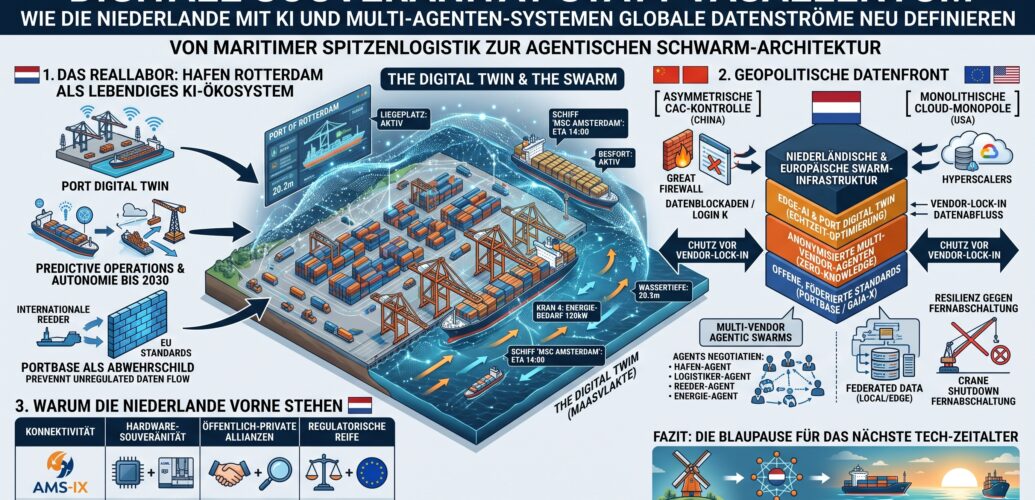
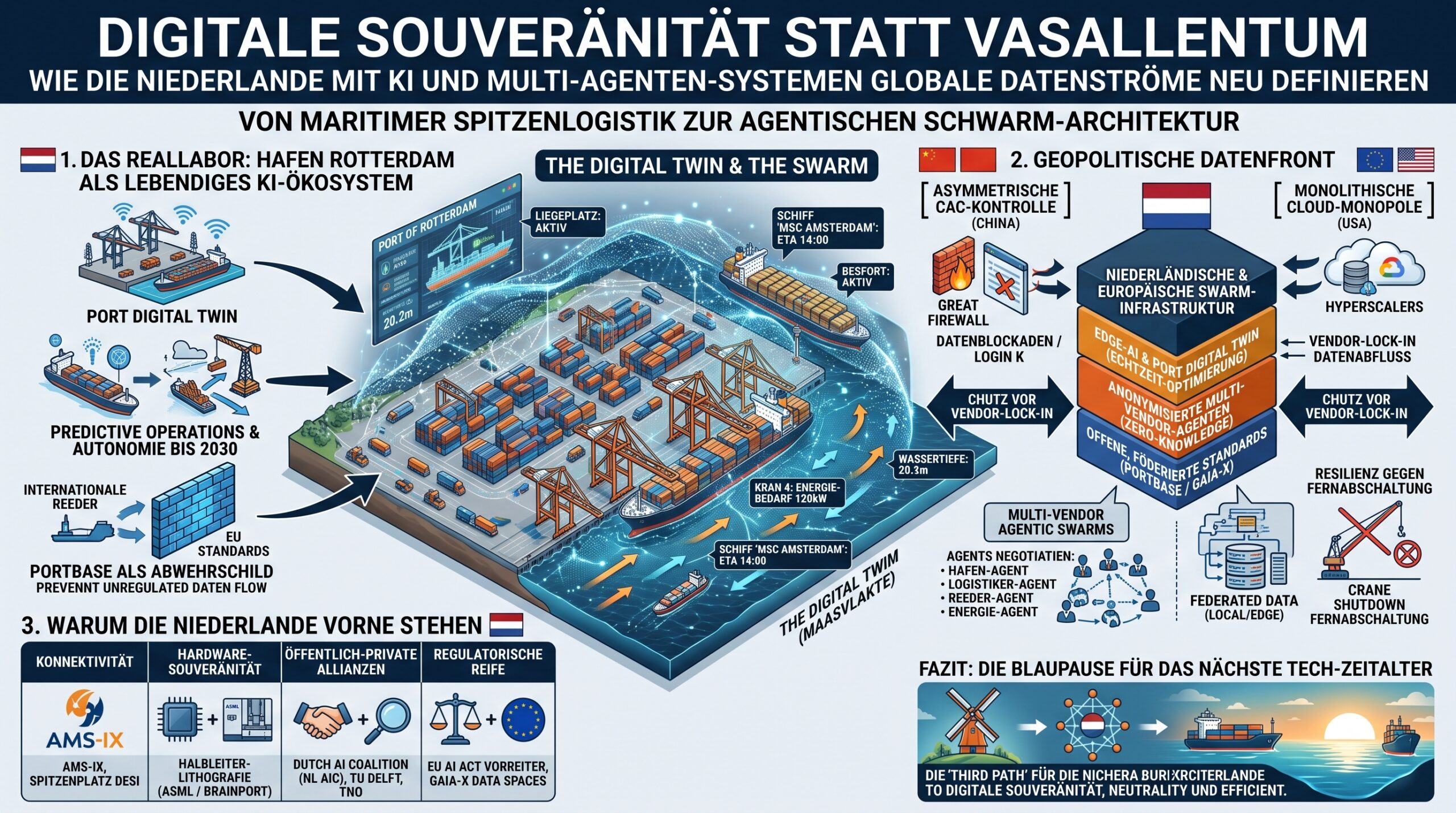
Nowhere is this technological leadership more tangible than at the Maasvlakte in Rotterdam. The port has long since ceased to be merely a transhipment area for physical goods; it is now a highly dynamic open-air data centre:
- The Port Digital Twin: Rotterdam mirrors its entire physical infrastructure in a virtual twin.
Hundreds of kilometres of quayside facilities, along with sensors for currents, wind, water depth and water levels, continuously feed machine-learning models.
Predictive Operations & Autonomy by 2030: Through the use of predictive AI systems, ships plan their berths, cranes plan their energy requirements and dredgers plan their routes with minimal downtime – with the clear aim of coordinating fully autonomous ship movements within the port by 2030.
Portbase as a protective shield: Rather than relying on Chinese data platforms such as Logink or US monopolies, Rotterdam has created its own neutral data ecosystem in the form of Portbase. International shipowners and logistics operators must comply with Dutch and European data standards if they wish to call at Europe’s most important cargo port.
2. Geopolitical data front: The response to China’s CAC and US hyperscalers
China’s data policy under the CAC is based on strict data localisation and asymmetric knowledge extraction: China demands maximum transparency from partners, yet blocks its own real-time logistics data in the name of ‘national security’. On the other hand, US platforms pose the threat of vendor lock-in, creating dependencies and uncontrolled data outflows.
It is precisely at this interface that modern Dutch architectural concepts come into play:
[ Asymmetric CAC control ] (China) ▲ │ (Data blockades / Logink) ▼┌─────────────────────────────────────────────────────────────┐│ Dutch & European swarm infrastructure ││ • Edge AI & Port Digital Twin (real-time optimisation) ││ • Anonymised multi-vendor agents (zero-knowledge) ││ • Open, federated standards (Portbase / Gaia-X) │└── ───────────────────────────────────────────────────────────┘ ▲ │ (Protection against vendor lock-in) ▼ [ Monolithic cloud monopolies ] (USA)The strategic lever: Multi-vendor agentic swarms
To protect itself from external influence, the infrastructure is evolving:
- Federated data storage & zero-knowledge: Data remains at the point of generation (edge/terminal) and is not exported to uncontrollable centralised clouds.
- Autonomous agent networks: Different vendors (terminals, logistics providers, shipping companies) allow their agents to negotiate in decentralised swarms (e.g. berth allocation, customs clearance, energy balancing) without disclosing trade secrets or strategic raw data.
- Resilience against remote shutdowns: Modular, multi-vendor architectures prevent vulnerabilities in imported hardware or software (such as Chinese gantry cranes) from being exploited as a digital lever against critical infrastructure.
3. Why the Netherlands is at the forefront of AI and digitalisation
Rotterdam’s technological sovereignty is not an isolated phenomenon, but the result of a nationwide, highly integrated digital ecosystem:
Pillar Status of the Netherlands Strategic significance
Connectivity & infrastructure AMS-IX is one of the world’s largest internet exchange points; top ranking in the EU DESI index. Extremely low latencies for real-time AI and multi-agent systems.
Hardware sovereignty Global centre for semiconductor lithography (ASML / Brainport Eindhoven). Without Dutch EUV precision, there would be no modern AI chips anywhere in the world.
Public-private partnerships Dutch AI Coalition (NL AIC) and close collaboration between TU Delft, TNO and industry. Rapid transfer of AI research into applicable industrial and port applications.
Regulatory maturity A pioneer in the implementation of the EU AI Act and data-sovereign data spaces (Gaia-X). Creation of legally compliant, trustworthy AI infrastructures without surveillance.
Conclusion: The blueprint for the next tech era
History shows that the Netherlands has always dominated whenever it has come to orchestrating complex global flows in a neutral, highly efficient and technologically superior manner.
In the age of autonomous agents, this means that anyone who does not wish to be at the mercy of either US platform monopolies or Chinese state surveillance must rely on anonymised, agent-based multi-vendor infrastructures. Rotterdam and the Dutch tech ecosystem demonstrate on a daily basis, in real-time operation, that this third way is not only theoretically conceivable but is already successfully setting new standards in the harsh reality of global trade.

