This post is based on a chat with Claude Opus 4.6, which I started after finding the article in my inbox: https://venturebeat.com/data/enterprise-ai-agents-keep-operating-from-different-versions-of-reality
EN
DE
NL
A VentureBeat article published this week described something that anyone working in enterprise AI should find deeply uncomfortable. Across large organizations, AI agents deployed in finance, operations, customer support, and supply chain are each carrying their own internal interpretation of the same core business concepts. One agent defines a “customer” as an account-level entity. Another defines it as an individual contact. One treats an order as “active” until the moment of shipping. Another until payment clears.
Nobody programmed them to disagree. Nobody told them to align either.
The article describes this as “institutionalized hallucination.” The agents aren’t failing visibly. They’re producing outputs that look plausible — but are built on incompatible foundations.
This is not a technology problem. It is a constitutional problem. And it has a solution that most organizations haven’t considered yet.
The question nobody is asking
Before you deploy your first agent — before you design governance models, configure protocols, or map agentic workflows — your organization needs to answer one foundational question:
Does your organization know who it is?
Not in a philosophical sense. In a practical, operational, machine-readable sense.
When you introduce agentic AI into your organization, you are not just adding technology. You are creating a team of non-human workers that will make decisions, take actions, and represent your company at speed and at scale — based on whatever understanding of your organization they were given at the start.
If that understanding is vague, inconsistent, or absent, your agents won’t fail dramatically. They’ll fail quietly. And the failures will compound.
What OrgDNA actually is
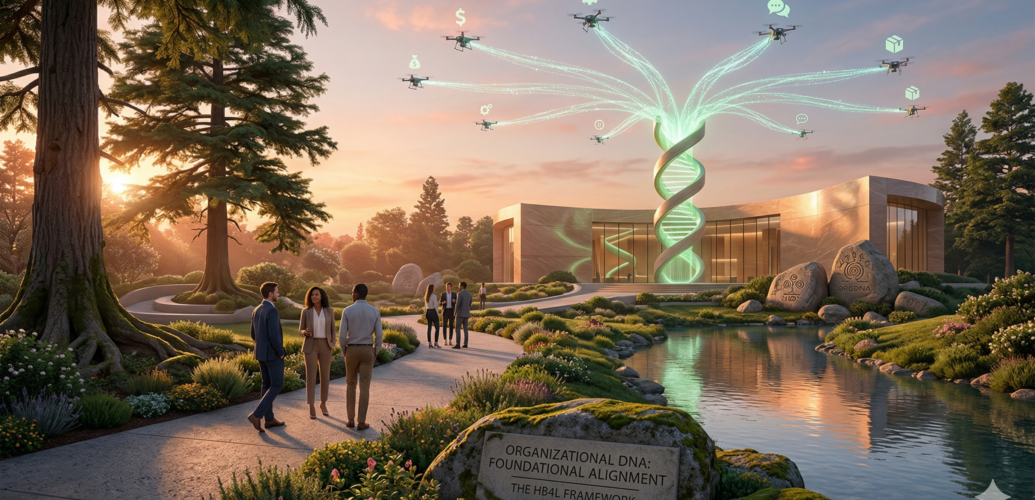
OrgDNA is a concept developed as part of the HB4L (Human Before the Loop) framework. It is the cognitive constitution of your organization — the single foundational document that every agent in your agentic team inherits before it does anything else.
It doesn’t tell agents what to do. It tells them how to think.
Think of biological DNA. It is present in every cell of an organism. It doesn’t consciously direct every action, but it shapes every behavior. It is invisible infrastructure. You don’t see it operating, but everything breaks without it.
Your OrgDNA works the same way. It travels with every agent deployment. It grounds every decision. It encodes your organizational values, your decision principles, your ethical boundaries, and your non-negotiables into a form that every agent — regardless of vendor, department, or task — can receive and reason from consistently.
The readiness gate
Here is the honest truth that most agentic AI implementations skip entirely: not every organization is ready to write its OrgDNA.
Before any design work begins, leadership needs to demonstrate it can answer one question with clarity and genuine alignment:
Who are we, and why do we exist?
This sounds simple. In practice, it is the question that gets postponed most often. Three meetings requested for more time. External support for the process declined. The vision deferred because there are more urgent priorities.
But here is what that pattern actually signals: if your leadership team cannot align on that answer without deflection, your agents won’t be able to either. They will inherit the organizational ambiguity — and operationalize it at machine speed.
A foggy OrgDNA produces foggy agents. At scale.
The readiness gate is structured around a simple Traffic Light logic. Green means leadership can articulate organizational vision and values with alignment and specificity — OrgDNA design can begin. Amber means partial clarity exists but significant gaps remain — foundational alignment work comes first. Red means no coherent organizational identity exists at leadership level — agentic deployment should not proceed.
Passing the readiness gate is not a bureaucratic checkbox. It is the moment your organization decides to take its agentic future seriously.
The OrgDNA Design Routine
For organizations that pass the readiness gate, OrgDNA is built through a structured five-step process:
Step 1 — Who Are We? Vision, mission, founding values. The reason your organization exists that predates any technology or market condition.
Step 2 — How Do We Think? Decision principles, priority frameworks, ethical boundaries. What guides judgment when no specific rule applies. This is the hardest step — and the most valuable.
Step 3 — How Do We Act? Behavioral standards, communication norms, escalation instincts. What good looks like operationally, across every department.
Step 4 — What Do We Protect? Non-negotiables. The things no agent is ever authorized to compromise, regardless of efficiency gains or competitive pressure.
Step 5 — Translation. Converting constitutional language into agent-readable instructions. Precision and deliberate simplicity — because ambiguous language produces ambiguous agent behavior.
The constitutional gate
OrgDNA is not owned by IT. It is not a vendor deliverable. It is owned by the organization — authored by those who carry the founding vision, ratified by those who will live and work under it across every department.
And it carries one absolute rule: no agent goes live without demonstrated alignment to the OrgDNA.
That is the constitutional gate. That is where Human Before the Loop begins.
| OrgDNA is a core concept in Agentic AI Transformation, co-created with Claude, publishing soon. Follow futureorg.digital for updates, or get in touch if the “different versions of reality” problem sounds familiar in your organization. |

