EN
DE
NL
If you want to watch the videos in another language, just choose the according subtitles
 We need your consent to load the content of YouTube.We need your consent to load the content of YouTube.We need your consent to load the content of YouTube.
In many conversations, I’m told that the topics I work on are “niche”:
geopolitics, AI, China, raw-material dependency, digital sovereignty.
The implication is always the same: interesting, but not relevant for everyday economic reality.
In truth, these topics are today’s economic reality.
Germany’s economy is no longer struggling because of short-term cycles. It is struggling because its structural foundations are eroding in parallel — energy, industry, technology, and geopolitics.
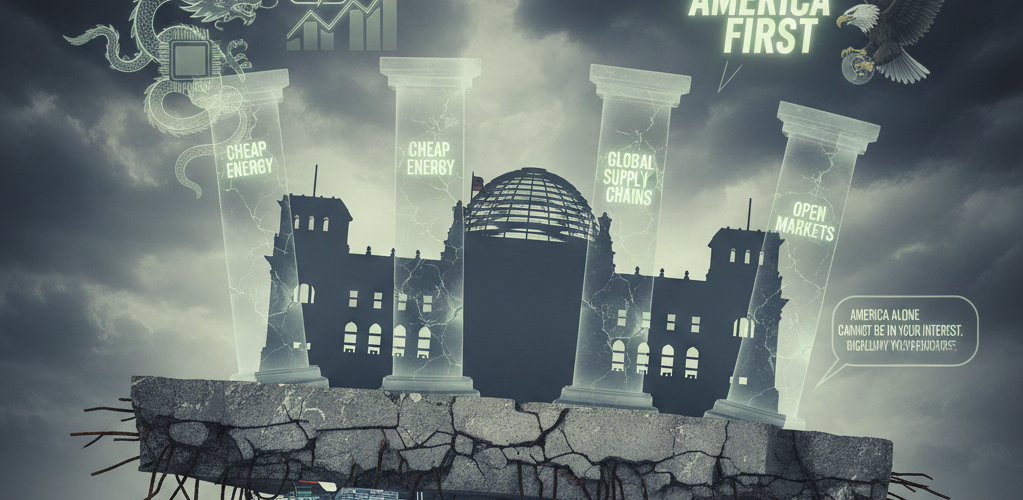
For decades, the German economic model was built on four stable pillars:
cheap energy, globalized supply chains, technological leadership in manufacturing and chemistry, and access to open world markets. All four pillars are now under severe pressure — simultaneously.
China controls large parts of critical raw-material processing and increasingly dictates industrial pricing power. The United States dominate cloud infrastructure, AI platforms, chips, and the digital value stack. Energy costs in Europe remain structurally higher than in competitor regions. And global trade has shifted from efficiency to power politics.
This is not a temporary downturn.
It is a change of the operating conditions of industrial capitalism.
Yet Germany is still debating its future largely in incremental terms: more subsidies here, another regulation there, another task force, another strategy paper. These are management tools for stable systems. Germany is no longer in a stable system.
The chemical industry illustrates the severity of the situation better than any other sector. Chemistry is not just another industry segment — it is the basis of almost all modern value chains: batteries, semiconductors, pharmaceuticals, hydrogen, materials science. Once chemical production relocates at scale, entire innovation ecosystems follow. What is happening now is not a relocation of capacity. It is a relocation of future industrial control.
The automotive sector has already lost its strategic leadership in electric mobility to China. Mechanical engineering is under increasing price and innovation pressure. Now chemistry is following. These were the core engines of German economic power.
What Germany is experiencing is not a cyclical recession. It is a slow systemic decoupling from the new centers of industrial gravity.
And socially, this decline is still largely discussed as if it were a mood problem: lack of confidence, too much pessimism, excessive risk awareness. But confidence cannot replace energy, raw materials, data, computing power, or AI platforms.
The uncomfortable truth is this:
Germany optimized efficiency for a world that no longer exists. It invested in processes while others invested in control points of value creation.
China invested in raw materials, processing capacity, and industrial policy.
The US invested in digital platforms, capital markets, cloud infrastructure, and AI ecosystems. Germany invested in cost optimization, regulation, and export dependency.
The result is visible now.
This does not mean Germany has no future. It means the future will not be a continuation of the past with minor adjustments. It requires strategic rupture, not administrative fine-tuning.
An industrial economy cannot be rebuilt with PowerPoint. And economic sovereignty cannot be achieved with regulatory comfort alone.
Germany is not collapsing. But it is running on structural exhaustion — and pretending that better communication will fix a system problem.
It won’t.
The Trump Warning That Europe Ignored
An uncomfortable truth has surfaced repeatedly in recent years — even in mainstream talk shows:
Donald Trump was strategically right about one core issue.
Not in style. Not in values. But in diagnosis.
For years, the United States warned Europe — bluntly, often offensively — that it was outsourcing its own security, industrial resilience, and strategic autonomy. Defense, energy, technology, supply chains. Europe was told, repeatedly:
You cannot free-ride forever.
Germany, in particular, chose to interpret this not as a strategic signal — but as noise.
Instead of rebuilding sovereignty in defense, energy, digital infrastructure, and industry, Germany doubled down on the assumption that:
-
the US would guarantee security,
-
China would remain a benign production partner,
-
and global trade would remain politically neutral.
That assumption is now officially dead.
With the new US security and industrial acts, the message is no longer rhetorical. It is institutionalized. The United States are restructuring their economy under national-security logic: defense, chips, AI, energy, and supply chains are now treated as strategic assets, not market commodities.
Europe — and especially Germany — is now reacting under time pressure to a reality it was told to prepare for years ago.
The irony is bitter:
The warning came in the wrong tone, from the wrong person, and was therefore politically ignored.
But the structural message was correct.
Germany mistook moral distance for strategic independence.
It refused to confront its own dependency because the messenger was uncomfortable.
Now the cost of that delay is no longer theoretical. It is written into energy prices, defense budgets, industrial relocation, and geopolitical margins of maneuver.
Strategic autonomy cannot be improvis ed when pressure is already at its peak. It must be built before it becomes necessary.
Germany didn’t just ignore Trump. It ignored the structural reality he pointed at.
And now it has to react under conditions it no longer controls.
Painful moment, which makes me feel ashamed:
Below an article with a quote of Germany’s Chancellor Merz. The article is in Germa, but you can translate it in your browser:
Merz warned the US against increasing isolation and offered Germany’s partnership. “In my talks with the Americans, I say: ‘America first is fine,’ but ‘America alone’ cannot be in your interest.” His message to the US was rather: “You also need partners in the world, and one of those partners can be Europe. And if you can’t do anything with Europe, then at least make Germany your partner,” Merz said during his inaugural visit to Rhineland-Palatinate.
Stripped of diplomatic packaging, it does not sound like a partner speaking. It sounds like a country asking not to be left out.

