EN
DE
NL
Whether you are a startup leader or an executive in a legacy enterprise, you’ve likely felt the “Agility Trap”: adopting the vocabulary of transformation while the old hierarchy remains quietly suffocating beneath the surface.
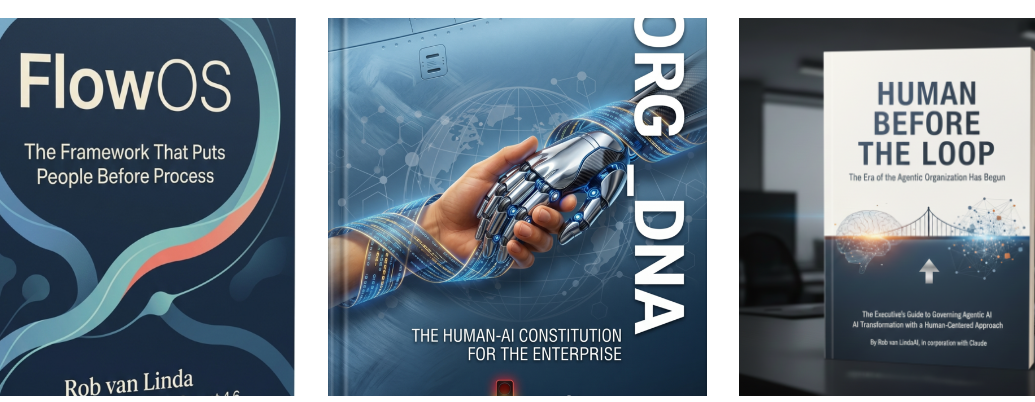
Rob van Linda’s Transformation Trilogy—comprising FlowOS, OrgDNA, and Human Before the Loop—provides a chronological roadmap to escape this trap. It moves an organization from fixing human coordination to establishing AI readiness, and finally, to governing fully autonomous agentic systems.
1. FlowOS: Putting People Before Process
Most transformations fail because they treat methodology as a solution rather than a vehicle. FlowOS is the “operating system” designed to remove the friction between intent and action.
-
The Empathy Session: Instead of top-down tasks, leadership starts by uncovering the “Empathy Gap”—the distance between those designing processes and the “firefighters” (frontline workers) who actually use them.
-
Co-Created Objectives: Leadership defines the Management Objective (strategic intent), but teams autonomously extract their own Team Objective (the “how”). This shifts the culture from compliance to ownership.
-
The Maker’s Schedule: Deep work is structurally incompatible with frequent interruptions. FlowOS replaces fragmented schedules with a rhythm that protects concentration, replacing disruptive daily standups with a purposeful Weekly Sync.
2. OrgDNA: The Human-AI Constitution
Before deploying autonomous agents, an organization must address the “Frozen Middle”—managers who resist AI out of an “identity threat,” fearing their expertise is being commoditized.
-
The Rob Layer: This framework combines Aviation Discipline (strict Standard Operating Procedures to ensure safety at speed) with Hospitality Empathy (ensuring employees, or “passengers,” feel safe enough to trust the AI “pilot”).
-
The Traffic Light System: To govern data and tasks, OrgDNA categorizes work into:
-
Green (Playground): Locally hosted sandboxes where employees can experiment safely without data leaving the building.
-
Yellow (Workspace): Collaborative zones with verified data.
-
Red (No-Go): Critical areas where AI is strictly prohibited.
-
-
Data Trust Cards: To solve the “spice rack problem”—where vector databases make all data look identical—this “permission slip” ensures agents only retrieve verified, labeled information.
3. Human Before the Loop: Governing the Agentic Era
As AI transitions from a tool into a “colleague with no common sense,” the final book shifts focus from Human-in-the-Loop (HITL) to Human Before the Loop (HB4L).
-
The HB4L Principle: Traditional HITL often turns humans into “passive janitors” who blindly approve outputs they don’t understand. HB4L requires humans to proactively design the context, boundaries, and accountability before an agent ever acts.
-
SwarmOS Governance Protocols:
-
MCP (Model Context Protocol): Enforces “least privilege,” giving agents access only to specific tools and data.
-
ACP (Agent Communication Protocol): Sets the global governance rules—the organizational “CSS stylesheet”—that all agents must follow.
-
A2H (Agent-to-Human): Defines five explicit escalation types (Inform, Collect, Authorize, Escalate, Result), so agents know exactly when to “raise their hand” to a human.
-
The Bottom Line
Agentic AI is not safe by default. The Transformation Trilogy argues that the technology only becomes trustworthy when the organization does the slow, unglamorous human work of preparation first.

